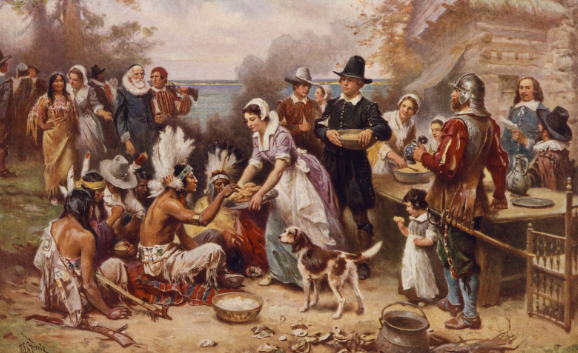
Stockton- Why do we eat turkey for Thanksgiving? There’s actually no historical evidence that there was turkey present on the day of the first Thanksgiving in 1621. The Plymouth Colony with the Indigenous Wampanoag people sat down for a feast which is now recognized as the first Thanksgiving. The settlers and Native Americans dined on venison, fish and shellfish as well as corn and other vegetables.
According to History.com, turkeys were plentiful in the region when the Pilgrims arrived, however, estimates put the total number of wild turkeys in North America at more than 10 million before European settlement began. In his history of Plymouth Plantation, written more than 20 years after the first Thanksgiving, the colony’s longtime governor William Bradford referred to a “great store of wild turkeys” around the time of that famous meal in 1621.
More Thanksgiving traditions we know today were popularized by a woman named Sarah Josepha Hale, who became known as the “mother of Thanksgiving.” She was a writer and editor and wrote an entire chapter from her 1827 novel about her native Thanksgiving traditions in New England. By 1854, thanks in large part to Hale’s work, more than 30 states and U.S. territories had an annual commemoration of Thanksgiving. President Abraham Lincoln made it official in 1863, declaring the last Thursday in November as a national Thanksgiving holiday. Hale described Thanksgiving as a feast with all foods imaginable with turkey as the centerpiece.
Today, due to industrialization of agriculture, the wild turkey has flourished and is able to be produced faster. According to FarmFlavor.com, the Broad breasted white turkey is the most common turkey bought for Thanksgiving and more than 46 million turkeys are consumed on Thanksgiving. Though there are questions about turkeys actually being there on the first Thanksgiving, the animal has become the face and symbol of the national holiday, giving thanks to all we as Americans hold dear.