

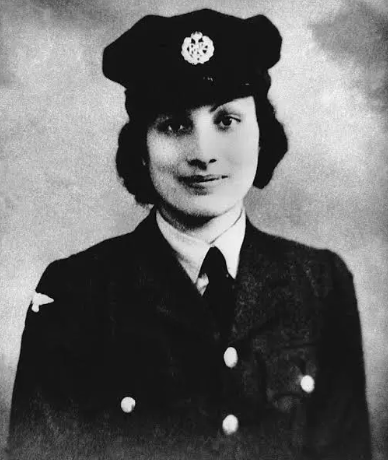
Stockton- The month of March is dedicated to celebrating women of all ages, all races, all occupations, and throughout human history. As a way of trying to celebrate some unsung female heroes, the Lincolnian will be selecting women throughout the month of March who have made great contributions to human history, but might not receive as much praise as they rightfully deserve. In today’s spotlight, we’re going to focus on the WW2-era British spy and secret agent, Noor Inayat Khan.
Noor-un-Nisa Inayat Khan was born on the 1st of January, 1914 in Moscow, Russia to her parents, an Indian father and an American mother. She was a direct descendant of Tipu Sultan, and her mother, Ameena Begum, was an accomplished writer and poet. Her father, Inayat Khan was an accomplished professor, musician, poet and writer.
In 1940, Noor joined the Women’s Auxiliary Air Force, a part of the British Royal Air Force, as an Aircraftwoman 2nd Class, where she was trained in the ways of a wireless communications operator. Later, Noor would be recruited by the SOE (Special Operations Executive), an organization formed in 1940 for the purpose of conducting espionage, reconnaissance, and sabotage within German-occupied Europe during WW2. The SOE recruited her as a radio operator, and sent her to have special training in order to serve as a wireless operator in enemy-occupied territory. Noor was the first woman to be sent over to Europe in this area of expertise, as all prior women serving in this field had been couriers rather than specially-trained agents, and she was fast and efficient at her craft, having had previous radio training and experience.
While in occupied-France, Noor became the “Prosper” resistance network’s radio operator in Paris. Starting in June of 1943, members of the network began to be arrested, but Noor chose to remain in France despite the danger, continuing her work while moving from place-to-place, hiding when necessary to stay safe. London eventually contacted Noor, asking her to return back out of the danger and severity of the situation, yet she insisted on staying, realizing she was the final radio link left between London and Paris. By August of that year, she was the only remaining British agent in Paris, so she began the arduous work of six radio operators while on her own, hiding out in Paris.
In October, Noor was sold out by a French woman and arrested by the Nazi’s police force, the Gestapo. In November of 1943, Noor was sent to Pforzheim prison in Germany, where she was kept chained in solitary confinement, as she was regarded as being “highly dangerous” by prison officials and the SS alike. Noor escaped and was re-captured on several occasions and, despite being repeatedly tortured and locked up, Noor refused to give up information to her captors, though information was still derived from her by her captors through written logs and other means.
Noor was eventually executed at Dachau concentration camp in 1944, and was posthumously awarded the George Cross, the highest British award for non-operational gallantry in 1949, and the French government awarded her the Croix de Guerre, a French military award created to honour people who fought with the Allied forces against the Axis powers.
So, why is Noor Inayat Khan’s story important today? Despite not receiving much recognition, Noor was an important, talented, and skillful secret operative in WW2 who played a significant role in espionage against the Axis powers. As a precursor to many modern intelligence agencies like the CIA and MI6, Noor’s work with the SOE can today be seen as a significant step in the intelligence community for women towards equality, representation, and power. Noor played an invaluable role in the resistance against oppression in WW2, and her service deserves to be honored this Woman’s History Month.


